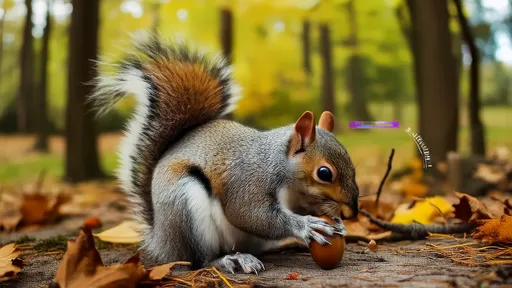
In the quiet corners of forests and urban parks, a remarkable cognitive feat unfolds each autumn as squirrels meticulously bury thousands of nuts and seeds. For centuries, observers assumed these scatter-hoarding rodents simply relied on luck or scent to recover their winter stash. Modern research, however, reveals a far more sophisticated system—one that rivals the memory techniques championed by ancient scholars and mental athletes. The humble squirrel, it turns out, is a natural master of the method of loci, commonly known as the memory palace technique.
The memory palace, a strategy dating back to Greek orators, involves associating information with specific spatial locations in a familiar environment. Squirrels employ a strikingly similar approach. Studies conducted at the University of California, Berkeley, demonstrated that fox squirrels not only remember the precise locations of their caches but also recall what type of nut is buried where and even whether it has been previously retrieved or remains intact. This isn’t mere instinct; it’s spatial memory of an exceptionally high order.
Researchers believe squirrels create cognitive maps of their territory, mentally tagging each burial site with unique environmental markers. A knotted root, a distinctive rock, or the way sunlight filters through a particular branch might serve as a mnemonic anchor. This allows them to navigate back to their caches months later, even under a blanket of snow. Their hippocampus—the brain region critical for memory and navigation—is proportionally larger and more active during caching seasons, highlighting the neurological investment in this task.
What’s truly astonishing is the scale. A single squirrel can create between 3,000 to 10,000 caches in a season. Remembering each one requires an organizational system. It’s thought that they don’t memorize every single hole as a discrete data point but rather chunk information, grouping caches by sector or type. They might, for instance, remember that a certain cluster of trees is a "walnut zone," and then use finer landmarks to pinpoint individual nuts within that zone. This hierarchical structuring is a key principle in advanced mnemonic systems used by humans.
Furthermore, squirrels engage in deceptive caching to protect their treasures from thieves. If a squirrel senses it is being watched, it will go through the elaborate motion of burying a nut—digging the hole, placing the nut inside, and covering it up—only to secretly retrieve the nut and bury it elsewhere later. This tactical deception requires a working memory to track the fake burial sites versus the real ones, adding another layer of complexity to their mental ledger. It’s a strategic game of chess played against potential pilferers, and their memory is the key to winning.
The parallels to the human memory palace are profound. Just as a mnemonist would place a vivid image of a concept to be remembered at a specific location in a familiar building, the squirrel places a physical nut at a specific location in its familiar landscape. Both systems rely on strong spatial awareness, associative learning, and the ability to serially recall items in a specific context. The squirrel’s survival through winter is directly tied to the fidelity of this mental map, a biological imperative that has honed this skill over millennia.
This incredible memory isn’t infallible, and that’s by design. The percentage of caches a squirrel ultimately recovers is estimated to be well below half. This "forgetting" is ecologically crucial, as the unrecovered nuts germinate into new trees, ensuring the forest's regeneration. The squirrel’s memory is thus a perfect balance of precision and productive failure, serving both the individual and the ecosystem. It is a natural algorithm optimized for survival and symbiosis.
In essence, the squirrel is a furry, four-legged grandmaster of mnemonics. Its brain performs intricate feats of spatial and associative memory that humans must train for years to achieve. The next time you see a squirrel darting across a lawn, pause to consider the immense cognitive landscape it navigates—a living library of hidden food, a memory palace written not in stone, but in soil and scent, ensuring its survival one perfectly placed nut at a time.

By /Sep 10, 2025

By /Sep 10, 2025

By /Sep 10, 2025
By /Sep 10, 2025

By /Sep 10, 2025

By /Sep 10, 2025
By /Sep 10, 2025

By /Sep 10, 2025

By /Sep 10, 2025

By /Sep 10, 2025
By /Sep 10, 2025

By /Sep 10, 2025

By /Sep 10, 2025

By /Sep 10, 2025

By /Sep 10, 2025

By /Sep 10, 2025

By /Sep 10, 2025
By /Sep 10, 2025

By /Sep 10, 2025

By /Sep 10, 2025