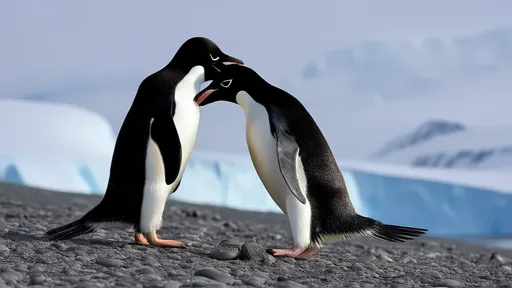
In the vast and icy landscapes of Antarctica, a peculiar real estate drama unfolds, one that involves tuxedo-clad residents with a penchant for property theft. Penguins, those beloved icons of resilience in the harsh polar environment, engage in a behavior that might seem charmingly mischievous at first glance but reveals a deeper struggle for survival and reproductive success: the pilfering of stones from each other’s nests.
For Adélie penguins and other stone-nesting species, these small, seemingly insignificant rocks are more than just pebbles; they are the foundational blocks of their homes. In a habitat where vegetation is nonexistent and snow dominates the scenery, stones become a precious commodity. They are used to construct raised nests that serve critical functions: elevating eggs and chicks above the cold, damp ground, providing drainage to prevent flooding, and offering a modicum of insulation against the biting cold. A well-built nest can mean the difference between a chick surviving or succumbing to the elements.
The competition for these stones is fierce. Prime nesting locations, often the same ones used season after season, are limited. The best spots are those that are slightly elevated, offering protection from meltwater and predators. However, these locations also come with a limited supply of suitable stones within easy reach. Once the immediately available rocks are gathered, the collection process becomes a laborious and time-consuming task. Penguins must waddle considerable distances to find new stones, expending precious energy in an environment where conservation of energy is paramount for survival.
This is where the behavior colloquially known as "stone stealing" enters the picture. Rather than embarking on a long and energetically costly journey to fetch a new stone, a penguin might opt for a quicker, albeit riskier, strategy: snatching a rock from a neighbor’s nest. The act is often swift and surreptitious. A penguin will wait until a nearby nest owner is distracted—perhaps preening, interacting with its mate, or looking away—then dart in, grab a choice stone with its beak, and quickly retreat to add it to its own structure.
The aftermath of such a theft is rarely quiet. The victim, upon discovering the pilferage, often reacts with loud, indignant calls and aggressive posturing. This can lead to brief but fierce squabbles, with much flapping of flippers and pointed pecking. These conflicts, while rarely causing serious injury, highlight the high stakes involved. The thief, if caught, might be forced to retreat empty-beaked or even lose a stone from its own nest in the ensuing scuffle. It’s a high-risk, high-reward strategy in the penguin world’s real estate market.
But why does this matter beyond being a curious anecdote? This behavior is a fascinating window into the evolutionary pressures faced by these animals. Stone stealing is not mere delinquency; it is a calculated trade-off. The energy saved by not foraging for a new stone can be significant. This energy can then be redirected into other vital activities, such as foraging for food for chicks, defending the nest from predators like skuas, or investing in self-maintenance to ensure the parent's own survival for future breeding seasons. In the ruthless calculus of natural selection, the benefits of occasionally stealing a stone can outweigh the costs of potential conflict for some individuals.
Furthermore, this behavior underscores a fundamental concept in animal behavior: resource defense. The nest, and the stones that comprise it, are a defended resource, crucial for reproductive fitness. Penguins are essentially defending their capital investment. The time and energy spent building the nest directly contribute to their chances of successfully raising offspring. A larger, more secure nest is more attractive to potential mates and provides a better environment for chicks. Therefore, defending it from thieves is a top priority.
Researchers studying these interactions have noted that stone theft is not a random act of chaos but follows certain patterns. It occurs more frequently in densely populated colonies where nests are packed closely together, making thievery easier and the scarcity of nearby stones more acute. It also seems that some individuals may be more prone to stealing than others, perhaps bolder or more opportunistic birds. Conversely, some nest owners are more vigilant and aggressive in defense, becoming less likely targets.
This avian "property market" even shows signs of economic strategies. Some penguins might engage in what could be likened to "property improvement" by carefully selecting only the smoothest, flattest stones that fit together snugly to create a more stable nest. The theft of such a premium stone is a greater loss and might provoke a more vehement response. The constant addition of stones throughout the breeding season, whether honestly foraged or deceptively stolen, signifies an ongoing investment in the property.
Observing these interactions forces us to reconsider the simplicity we often assign to animal behavior. The penguins’ stone-stealing antics are a complex interplay of economics, strategy, and social dynamics. It is a tangible manifestation of the competition for limited resources, a theme universal across the animal kingdom. From birds of paradise decorating their leks to bowerbirds collecting blue objects, animals go to great lengths to secure the best possible chances for their offspring. For the penguin, the currency is stone, and the bank is its nest.
Ultimately, the tale of the thieving penguin is more than a quirky fact. It is a story about the universal drive to provide for one’s family, the clever and sometimes cunning strategies employed to overcome environmental challenges, and the endless competition that shapes life on Earth. The next time you see an image of a penguin, solemnly standing by its nest, remember that behind those soulful eyes might be the mind of a savvy real estate mogul, constantly calculating its next move in the relentless game of Antarctic property acquisition.

By /Sep 10, 2025

By /Sep 10, 2025

By /Sep 10, 2025

By /Sep 10, 2025

By /Sep 10, 2025

By /Sep 10, 2025
By /Sep 10, 2025

By /Sep 10, 2025

By /Sep 10, 2025

By /Sep 10, 2025
By /Sep 10, 2025

By /Sep 10, 2025
By /Sep 10, 2025

By /Sep 10, 2025

By /Sep 10, 2025

By /Sep 10, 2025

By /Sep 10, 2025
By /Sep 10, 2025

By /Sep 10, 2025

By /Sep 10, 2025