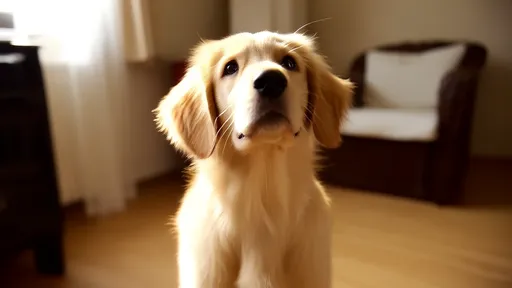
If you've ever spent time around dogs, you've likely witnessed the classic head tilt—that adorable, quizzical cock of the head that seems to say, "I'm listening" or "I'm trying to understand." Often dubbed the "head tilt" or "canine head cock," this behavior is so endearing that it's frequently interpreted as a deliberate attempt to be cute, hence the term "head tilt kill" in Chinese pop culture. But is this charming gesture truly a calculated display of canine charm, or is there more beneath the surface? As it turns out, science suggests that the head tilt is far from mere theatrics; it's a complex behavior rooted in sensory processing, communication, and cognitive function.
Dogs, like humans, rely heavily on their senses to interpret the world around them. Their hearing is particularly acute, capable of detecting frequencies far beyond the human range. When a dog tilts its head, it may be attempting to better localize a sound. The anatomy of a dog's ear plays a significant role here. While human ears are relatively fixed, a dog's ears are mobile and can be independently adjusted to capture sounds from different directions. By tilting the head, a dog might be fine-tuning the position of its ears to pinpoint the source of a noise more accurately. This is especially useful when the sound is unfamiliar or particularly intriguing, such as a new word from their owner or an unusual noise from the television.
Beyond auditory refinement, the head tilt also appears to be linked to visual perception. Dogs have longer muzzles than humans, which can sometimes obstruct their field of vision. When a dog tilts its head, it might be trying to get a better view of a person's face, particularly the mouth and eyes, which are key areas for reading human emotions and intentions. Research has shown that dogs are adept at interpreting human facial expressions and vocal cues. The head tilt could therefore be a mechanism to enhance visual access to these critical social signals, allowing the dog to gather more information about what its human is communicating.
Interestingly, the head tilt isn't just about sensory optimization; it also has a social dimension. Dogs are highly attuned to human reactions, and they quickly learn that certain behaviors elicit positive responses from their owners. If a dog tilts its head and receives praise, attention, or treats, it's likely to repeat the behavior. This doesn't necessarily mean the dog is "faking" the tilt to manipulate humans, but rather that it has learned through reinforcement that the gesture is rewarding. In this sense, the head tilt can become a conditioned response, blending innate sensory behavior with learned social interaction.
Some studies have even suggested a link between the head tilt and cognitive processing. For instance, dogs that tilt their heads more frequently might be those that are particularly engaged or trying to solve a problem. This is often observed in working dogs or those trained for complex tasks, where the head tilt appears during moments of concentration or when they are processing familiar commands in new contexts. It's as if the physical act of tilting the head helps them "shift gears" mentally, allowing for better information processing and recall.
Of course, not all head tilts are created equal. In some cases, a persistent or exaggerated head tilt can be a sign of medical issues, such as ear infections, vestibular disease, or neurological disorders. It's important for dog owners to distinguish between the occasional, context-appropriate head tilt and one that seems abnormal or accompanied by other symptoms like loss of balance or disorientation. The typical "cute" head tilt is usually brief, situational, and paired with other signs of alertness or curiosity.
So, is the dog head tilt really about "selling cute"? In a way, yes—but not in the conscious, manipulative way humans might assume. Instead, it's a multifaceted behavior that serves practical purposes related to hearing, vision, and social bonding. The fact that humans find it irresistibly charming is almost a happy accident, one that has strengthened the human-canine bond over centuries of coexistence. The next time your dog gives you that adorable head tilt, remember that it's not just trying to win your heart; it's also optimizing its senses to understand you better.
In conclusion, the endearing canine head tilt is a fascinating blend of sensory adaptation, social learning, and cognitive effort. While it may seem like a simple gesture, it reflects the sophisticated ways dogs interact with their environment and the humans they love. So, the next time you see a dog cock its head, appreciate it not just for its cuteness, but for the remarkable biological and social mechanisms that make it possible.
By /Sep 10, 2025

By /Sep 10, 2025

By /Sep 10, 2025
By /Sep 10, 2025
By /Sep 10, 2025

By /Sep 10, 2025
By /Sep 10, 2025

By /Sep 10, 2025

By /Sep 10, 2025
By /Sep 10, 2025

By /Sep 10, 2025

By /Sep 10, 2025

By /Sep 10, 2025

By /Sep 10, 2025
By /Sep 10, 2025

By /Sep 10, 2025

By /Sep 10, 2025

By /Sep 10, 2025
By /Sep 10, 2025
By /Sep 10, 2025