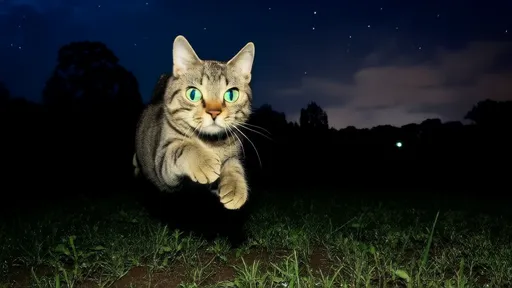
If you share your home with a feline friend, you are likely no stranger to the phenomenon known as the "midnight crazies." Just as you are drifting into a deep and peaceful slumber, a thunder of tiny paws erupts overhead. Your cat, seemingly possessed by a sudden and frantic energy, tears through the house at breakneck speed, leaping from furniture to bookshelf to the top of the refrigerator, often accompanied by the occasional chirp or yowl. While this 2 a.m. Grand Prix might be a baffling and sleep-disrupting mystery to us, to our cats, it is simply a natural expression of their fundamental, hardwired nature as crepuscular predators.
The domestic cat, Felis catus, is a direct descendant of wild ancestors who were solitary hunters. Their survival depended on their ability to hunt effectively, and the cover of dusk and dawn provided the perfect conditions. This twilight period, known as crepuscular, is when many of their preferred prey—small rodents and birds—are most active. The low light offers them camouflage from both their prey and their own potential predators. Over millennia, their entire physiology and behavioral rhythm became perfectly synchronized with this cycle. Their eyes evolved to possess a high number of rod cells, making them exceptionally adept at seeing in dim light. Their hearing became incredibly sensitive, capable of detecting the faintest scuttle of a mouse in the undergrowth. Even their whiskers, or vibrissae, act as precise environmental sensors for navigating tight spaces in near darkness.
When we bring these magnificent little predators into our homes, we provide them with food, shelter, and safety. We remove the evolutionary pressure to hunt for survival. However, we cannot so easily remove the millions of years of instinct that are coded into their very DNA. The house cat may not need to hunt, but the primal urge to do so remains powerfully intact. Your living room may be safe and predictable, but your cat's internal clock is still set to the ancient rhythm of the wild. As the sun sets and your household winds down, your cat's ancient programming begins to boot up. The quiet and stillness of your home at night inadvertently mimics the conditions of their ancestral hunting grounds, triggering a deep-seated instinct to patrol, explore, and hunt.
This surge of instinctual energy is what we witness as the "zoomies" or "midnight run." It is not random madness; it is a compulsive expression of pent-up predatory energy. In the wild, a cat would spend a significant portion of its night stalking, chasing, pouncing, and killing. This is high-intensity exercise. The modern indoor cat, despite having its food bowl generously filled, still possesses that same reservoir of energy with very few natural outlets. Without a real hunt to engage in, this energy has to go somewhere. It builds up throughout the evening until it explodes in a burst of frantic activity—a simulation of the hunt, complete with imaginary prey. That leaping pounce onto a crumpled piece of paper? In your cat's mind, that might very well be a final, lethal strike on a mouse.
Furthermore, our own daily routines can unintentionally exacerbate this natural behavior. Many house cats spend long hours alone and relatively inactive while their human companions are at work or school. A cat may nap for most of the day, storing a tremendous amount of energy. Then, just as you return home in the evening and are perhaps too tired to engage in a lengthy play session, your cat is reaching its peak activity period. If this energy is not adequately expended through interactive play before your bedtime, the infamous 2 a.m. wake-up call is almost guaranteed. The cat, having slept all day and with its instincts now fully awakened by the night, is simply ready to play and hunt because its body is telling it that it is time to go to work.
Understanding that this behavior is a normal and healthy expression of your cat's innate instincts is the first step toward achieving a more peaceful coexistence. The goal is not to punish the behavior but to redirect this natural energy into more appropriate and human-sleep-friendly channels. The most effective strategy is to actively mimic the natural hunt-eat-groom-sleep cycle. Dedicate 15-20 minutes each evening to a vigorous interactive play session. Use wand toys that mimic the flight of a bird or the scuttle of a mouse, encouraging your cat to run, jump, and pounce. This allows them to act out their predatory sequence. Conclude the play session with a small meal or treat. In the wild, a cat would hunt, catch, kill, and then eat its prey. By replicating this pattern—play (hunt) followed by food (the reward)—you help satisfy their deep instinctual cravings. A cat that has successfully "hunted" and "eaten" is far more likely to feel content and settle down for a long groom and sleep, rather than rehearsing their parkour skills on your head at 3 a.m.
In conclusion, the next time you are jolted awake by the sound of your cat galloping through the hallway, try to see it not as a nuisance, but as a fascinating glimpse into the wild soul of your domesticated companion. That frantic energy is a direct link to their ancestors—a ghost of instincts past, demanding to be exercised. It is the echo of the African wildcat, alive and well in your apartment. By acknowledging and engaging with this fundamental part of their nature through scheduled play and environmental enrichment, we can help our feline friends lead more fulfilled lives while also reclaiming our own precious sleep. The midnight run is not a behavior problem to be solved, but a conversation to be had with the wild heart beating inside your domestic pet.

By /Sep 10, 2025
By /Sep 10, 2025

By /Sep 10, 2025
By /Sep 10, 2025

By /Sep 10, 2025

By /Sep 10, 2025
By /Sep 10, 2025

By /Sep 10, 2025
By /Sep 10, 2025

By /Sep 10, 2025

By /Sep 10, 2025

By /Sep 10, 2025

By /Sep 10, 2025

By /Sep 10, 2025

By /Sep 10, 2025

By /Sep 10, 2025

By /Sep 10, 2025
By /Sep 10, 2025
By /Sep 10, 2025

By /Sep 10, 2025